

Vicks products are available for purchase online and in-store at most major retailers.
VICKS SUPPORT
View product-specific FAQs & videos
Choosing a small warm mist humidifier is about more than fitting a compact appliance on a bedside table. The right model should suit the room, be simple to clean, and offer controls you can use without fumbling in the dark. Warm mist units heat water, so safe placement matters, especially in homes with children or pets. A little caution belongs in the buying process.
Indoor-air consultant and author Jeffrey C. May has written about how moisture and household conditions affect indoor air. A practical paraphrase of that guidance is: “Consider the room’s conditions, not just the appliance.” This is a summary, not a verified direct quotation. It points to a useful question: will the humidifier’s output fit your space, or will it leave the windows damp?
This guide looks at seven details worth checking before you buy: room coverage, tank capacity, cleaning access, operating noise, automatic shutoff, controls, and ongoing costs. Picture lifting the tank over a bathroom sink, wiping its corners, or reaching for the power button at night. Those small tasks can shape daily use more than a sleek product photo suggests. No model is effortless. Compare the manual and care instructions, and check whether replacement parts are easy to find. A small warm mist humidifier can be a sensible choice, but only when its maintenance and safety features match your household.
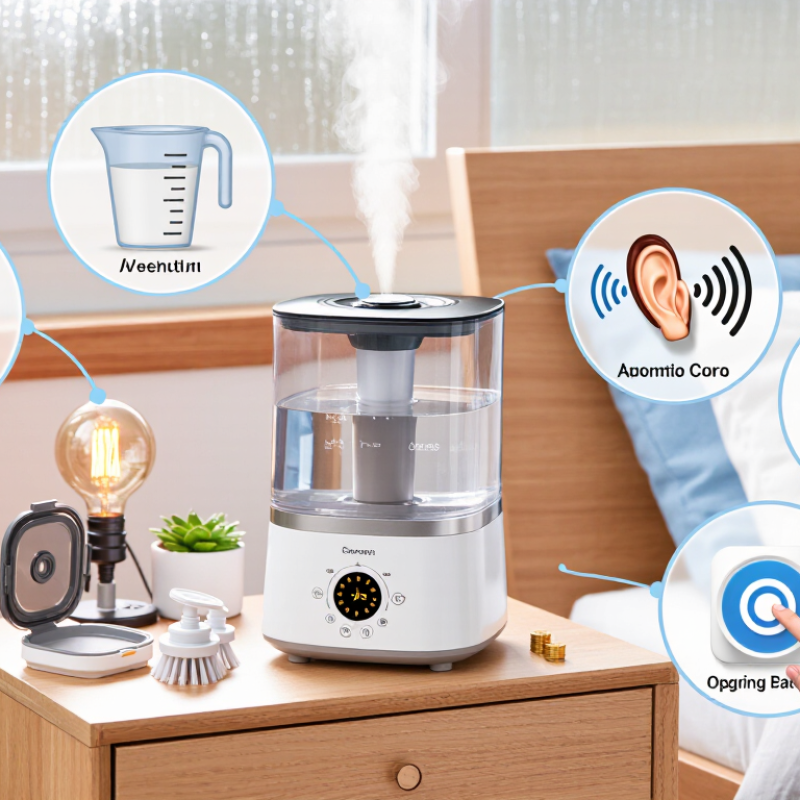
Before choosing a small warm-mist humidifier, match its rated coverage area to the room where it will run. Measure the bedroom or office, not the entire floor plan. Check the unit’s moisture output, usually listed in gallons per day, as well as its stated room size. A closed door, drafty window, or high ceiling can change how quickly humidity rises. Small details matter.
Use a basic hygrometer to check the room’s relative humidity before and after running the unit. The U.S. EPA’s A Brief Guide to Mold, Moisture and Your Home advises keeping indoor humidity below 60%, ideally between 30% and 50%. If your room already sits near that range, a smaller output may be enough. If it remains dry, a compact unit may struggle in a large space. Room-size ratings are useful, but they are estimates—not promises.
Tip: Place the humidifier away from curtains and cold windows, then recheck the reading after a few hours. Measure twice. I would not assume one evening’s result tells the whole story; outdoor weather and heating can shift indoor humidity overnight.
A small warm mist humidifier’s tank capacity tells you how often you may need to refill it, but it does not predict performance by itself. A compact unit with a 1-liter tank might suit a bedside table if it runs through the night on a low setting. A larger tank can reduce refill trips, though it may take up more space and feel awkward to carry to the sink. Check whether the tank opening is wide enough for easy cleaning.
Runtime is useful only when you know the setting behind the number. High mist output usually uses water faster, so a listed ten-hour runtime may apply only at the lowest setting. Numbers can mislead. Compare runtime at the output level you expect to use, and leave some room for differences in room temperature, humidity, and ventilation. I would not treat any advertised runtime as a guarantee.
Mist output, often listed in milliliters per hour, helps you judge whether a unit can keep pace with your room. Match that figure to the room size recommended in the product specifications; more output is not automatically better in a tiny bedroom. Too much moisture can leave windows damp or nearby surfaces clammy. Place the humidifier on a stable, water-resistant surface, away from bedding and the edge of a table, then adjust the setting after observing the room.
A small warm mist humidifier sits close to everyday life, so safety deserves a close look. Check for automatic shutoff when the water runs low. A tip-over switch can also reduce risk if the unit gets bumped. Warm mist can cause burns, so choose a model with a stable base and handles that stay cool. Keep it away from children, pets, bedding, and curtains. Read the safety instructions before using it, even if the controls seem obvious. Small details matter.
Ease of use affects whether you clean and refill the humidifier regularly. Look for a tank that lifts out easily and has a wide opening for rinsing. A clear water-level window helps prevent guesswork, while simple buttons are easier to manage in a dim bedroom. Check whether the power cord reaches a safe outlet without crossing a walkway. It is tempting to choose the smallest unit, but a tiny tank may need frequent refills. That can become annoying. Also check how the manufacturer recommends removing mineral buildup; awkward cleaning steps are easy to put off. A recognized electrical safety certification mark can offer added reassurance, but it does not replace careful placement and routine maintenance. I would not judge a humidifier by its feature list alone. Picture filling it at the sink on a rushed morning—that is a useful test.
A small warm mist humidifier can be easy to place on a nightstand, but its cleaning routine matters more than its footprint. Mineral deposits may collect around the heating chamber, especially when tap water leaves white scale on faucets or kettles. Look for a tank opening wide enough for your hand or a soft brush. Removable parts with simple shapes are easier to rinse and dry. Narrow corners? They can be annoying.
Tip: Check the care instructions before buying. Confirm which parts need regular cleaning, how often the manufacturer recommends it, and whether the electrical base must stay dry. Never assume a part is dishwasher-safe. Unplug the unit and let it cool before handling it; warm mist models can retain heat after use.
Also check whether replacement parts are available, including seals, caps, or any model-specific filters. Not every warm mist humidifier uses a filter, so verify rather than budgeting for one automatically. A replacement part should match the exact model, since a poorly fitting seal can cause leaks. I find this detail easy to overlook when comparing prices. A low-cost unit may be less convenient if a small, essential part is difficult to replace. Keep the model number somewhere visible. A sticky note works.
| Tip | What to Assess | Practical Buying Check | Cleaning or Replacement Consideration |
|---|---|---|---|
| 1. Check how the tank opens | Tank opening size, handle, and access to corners | Look for an opening wide enough for a cleaning brush and a tank that can be handled without awkward twisting. | A narrow opening or deep corners can make regular cleaning more difficult; check whether the tank is dishwasher-safe rather than assuming it is. |
| 2. Inspect access to the heating area | Whether the heating chamber and surrounding surfaces are reachable for descaling | Review the cleaning instructions and confirm that the unit can be unplugged and cooled before the heating area is cleaned. | Mineral deposits can collect around heated surfaces. Use only the descaling method approved in the manual, and never immerse the electrical base. |
| 3. Compare routine cleaning instructions | Recommended cleaning frequency and required steps | Prefer instructions that clearly distinguish routine rinsing from periodic descaling and disinfection. | Cleaning frequency depends on use and water hardness. Follow the manufacturer’s schedule; empty and dry the tank when the unit will not be used. |
| 4. Find out whether a filter is required | Filter type, availability, and stated replacement schedule | Check the product specifications and manual for a required water filter or other consumable. | Some warm mist models do not use a replaceable filter. If one is required, confirm the part is sold separately and check its stated service interval. |
| 5. Verify access to replacement parts | Availability of items such as tanks, caps, gaskets, and power cords | Search the support documentation or parts list before buying, especially if a removable component looks easy to damage or lose. | Part availability varies by model. Do not assume a tank, seal, or cord is replaceable unless the manufacturer lists it as a service part. |
| 6. Consider mineral buildup in your area | Local water hardness and the unit’s advice on water type | If your tap water is hard, check whether the manual permits distilled or low-mineral water and whether that could reduce scale buildup. | Hard water can leave mineral deposits that require more frequent descaling. Water recommendations differ, so follow the instructions for the specific model. |
| 7. Review safety and service guidance | Cool-down instructions, tip-over protection, and user-serviceable components | Choose a design with clear safety instructions and stable placement, and check what the warranty says about cleaning and repairs. | Warm mist units heat water and can cause burns. Unplug and allow the unit to cool before cleaning; do not attempt to replace internal heating or electrical components unless instructed. |
7 Tips for Buying a Small Warm Mist Humidifier
Noise, energy use, and upkeep can change a humidifier’s real cost. Check the sound rating in decibels, or dBA, and note the measurement distance. A rating without distance is hard to compare. Listen for bubbling or clicking, too; a low fan rating may not capture those sounds. Small details matter at night.
Read the power label before estimating energy costs. For example, a 300-watt unit running eight hours daily uses about 72 kilowatt-hours monthly. At the U.S. 2024 average residential electricity price of 16.48 cents per kilowatt-hour, that is roughly $11.87 a month. This estimate uses U.S. Energy Information Administration data from Electric Power Monthly; local rates and actual run time will change the bill. Not a promise.
Include descaling and replacement parts in your cost comparison. Hard-water deposits can mean more frequent cleaning, while some designs need replaceable components. Check the manual’s care schedule and part prices before buying. A cheaper unit may cost more over a heating season. I would also compare noise at the setting you actually use, not just the quietest mode. That part is easy to overlook.
Compare noise, energy use, and overall cost before choosing a model.
Estimated annual electricity cost: Calculated for 8 hours of use per day, 365 days per year, at $0.17 per kWh. The 200 W, 300 W, and 400 W examples use about 584, 876, and 1,168 kWh per year, respectively. These are power-use scenarios, not measurements of specific products; actual use and local electricity rates vary. The estimates exclude the purchase price.