

Vicks products are available for purchase online and in-store at most major retailers.
VICKS SUPPORT
View product-specific FAQs & videos
A Metal Cutting Board can look sleek on a kitchen counter, but appearance is only part of the decision. The World Health Organization’s 2015 estimates linked contaminated food to 600 million illnesses worldwide each year. That figure makes everyday cleaning choices worth considering. It does not prove that one board material is automatically safer. USDA food-safety guidance instead emphasizes washing cutting boards and preventing cross-contamination between raw foods and ready-to-eat ingredients.
Food-safety specialist Dr. Ben Chapman of North Carolina State University has emphasized the practical importance of cleaning and sanitizing food-contact surfaces. In paraphrase: choose a board you can clean thoroughly and use consistently. That advice matters when comparing stainless steel with other options. A smooth, food-grade steel surface may be easy to wipe down, yet a slick board can let a knife or tomato slide. Steel may also feel hard on knife edges and create a sharp clatter under a chef’s knife. Check the material, finish, stability, and care instructions before buying. Look for a food-contact grade and rounded, well-finished edges. Then consider where the board will sit: a wet countertop, a crowded sink, or a small drawer can change what feels practical. The best choice is not always the most polished one. A detail is easy to miss: “metal” describes a broad category, not a single performance standard. This guide compares the features that matter, so you can choose a board suited to your cooking habits and cleaning routine.
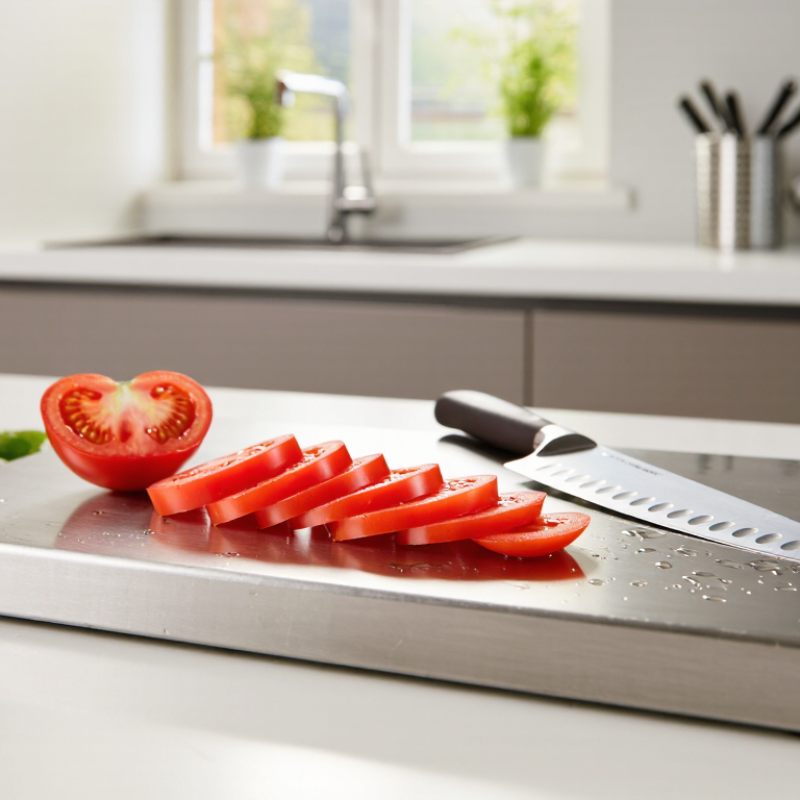
Before choosing a metal cutting board, be clear about what you will cut on it. Stainless steel can suit dough shaping, portioning soft foods, or tasks where a smooth, nonporous surface is useful. It is less forgiving for repeated knife work. The hard surface can dull an edge faster than wood or plastic, and chopping may sound sharp in a quiet kitchen. Consider your knives, too. A board that cleans easily is not automatically the best board for every task.
Measure the work area, not just the board you like. Leave room for a knife handle, a bowl, and your hands; a board that crowds the counter can make routine prep awkward. Check the space near the sink and stovetop, and measure the storage slot if the board will be put away. Small detail. A heavy metal board may shift on a slick countertop, so check for a stable base or use a suitable nonslip mat. Also consider its edges: raised lips can help contain liquid, but they may reduce usable cutting space. Measurements can feel fussy, and I might still misjudge the fit by an inch; tape out the board’s footprint before buying.
How to Choose the Best Metal Cutting Board?
Compare 304 and 316 Stainless Steel by ASTM A240 Alloy Ranges
ASTM A240 specifies chemical composition ranges for stainless-steel plate, sheet, and strip. Grade 304 typically contains 18–20% chromium and 8–10.5% nickel. Grade 316 contains 16–18% chromium, 10–14% nickel, and 2–3% molybdenum. Check the exact grade and current specification edition before comparing material certificates; low-carbon variants, such as 304L and 316L, have different carbon limits.
That molybdenum matters. It improves resistance to chloride-related pitting, which can occur when salty food residue stays on a damp surface. For ordinary kitchen exposure, 304 may be adequate; frequent contact with salt or acidic ingredients may make 316 worth considering. Neither alloy is immune to staining or surface damage. A knife can leave fine scratches, and a steel board may feel hard under the blade.
The alloy range is only part of the decision. ASTM A240 describes material chemistry and product requirements, not whether a board’s finish, thickness, edges, or construction suit food preparation. I would not choose by the grade number alone. Ask for the documented alloy grade, inspect the finished surface, and consider how the board will be cleaned and used. That detail is easy to overlook.
When choosing a metal cutting board, inspect its thickness, flatness, and edge finish in person if possible. A thin sheet may flex under pressure, especially when you chop firm vegetables or press a knife through dense food. I would not assume thicker is always better; added weight can make a board awkward to lift and clean. Press gently near each corner and the center. Notice any movement.
Lay the board on a level counter and check for rocking, gaps, or a visible bow. A warped surface can shift during prep and make scraps harder to control. Look across the board under bright light. Reflections can reveal dips, raised areas, or rough spots that are easy to miss from above. Small details matter.
Run a fingertip carefully along the edges, without sliding it across a sharp corner. The finish should feel smooth, with no burrs or jagged seams that could catch a cloth or skin. Rounded edges are often more comfortable to handle, while a clean underside helps prevent scratches on the counter. Metal is hard, and it can wear a knife edge faster than softer boards, so consider how you plan to use it. A quick inspection helps, but it is not a substitute for checking the board after regular use.
A metal cutting board can look simple: a flat sheet, smooth edges, and no visible cracks. But appearance alone cannot prove that it meets food-equipment sanitation requirements. Metal alone isn’t enough.
Check whether the exact product model is certified to NSF/ANSI 2, a standard for the materials, design, construction, and performance of food equipment. Certification applies to listed products and conditions, not automatically to every metal board. Search the certifier’s product directory, and compare the model number and intended use with the supplier’s documents. A general statement such as “food safe” is not the same as a verified certification claim. That distinction is easy to miss.
Inspect the board’s physical details, too. A rough weld, rolled edge, or deep scratch can trap residue and make cleaning harder. Ask how the board should be washed, sanitized, and maintained, then follow those instructions. A smooth surface can still be damaged. Also consider knife wear: a hard metal surface may dull blades faster than softer cutting materials. I’d want clear documentation before trusting a sanitation claim; I might still have questions about daily cleaning.
| Evaluation Factor | What to Check | Practical Guidance | Claim Check |
|---|---|---|---|
| NSF/ANSI 2 scope | NSF/ANSI 2 covers food equipment sanitation requirements, including aspects of materials, design, construction, and performance. | Check whether the exact board model is certified or listed for the intended use, and confirm the applicable standard in the certifier’s directory. | “Made of metal” does not, by itself, establish NSF/ANSI 2 certification. |
| Certification evidence | Look for a verifiable listing that identifies the product or product category and the applicable certification standard. | Match the model and intended use to the listing. Ask the supplier for documentation if the claim cannot be independently verified. | A logo, brochure statement, or claim that a product is “NSF compliant” is not a substitute for a verifiable listing. |
| Food-contact material | Identify the exact alloy or other food-contact material and confirm that it is suitable for the foods, cleaning chemicals, and operating conditions involved. | Stainless steel grades such as 304 and 316 are commonly used in food equipment; 316 generally offers greater corrosion resistance in chloride-containing environments. | “Stainless steel” alone does not identify a grade or prove suitability for every food-contact application. |
| Surface and fabrication | Inspect for cracks, pits, rough areas, open seams, burrs, and joints that could trap food residue or moisture. | Prefer a smooth, intact, readily accessible surface and construction that can be cleaned and inspected thoroughly. | A nonporous metal surface can be cleanable, but it is not automatically sanitary if the design or condition creates hard-to-clean areas. |
| Cleaning and sanitizing | Check the manufacturer’s instructions for washing, rinsing, sanitizing, drying, and any chemical or temperature limits. | Use the cleaning and sanitizing procedure appropriate to the food operation and the board’s documented compatibility. | Metal is not inherently self-sanitizing or bacteria-proof; sanitation depends on effective cleaning and sanitizing practices. |
| Knife performance | Consider how the hard metal surface will interact with the knives used in the operation. | Metal can dull or damage knife edges more quickly than common cutting-board materials such as polyethylene or wood. | Claims that a metal board is “knife-friendly” should be supported by product-specific evidence and practical evaluation. |
| Stability and handling | Check the board’s weight, edge finish, grip, and resistance to movement on the work surface. | Choose a size and design that can be handled safely and secured during cutting; smooth metal may be slippery when wet. | Do not assume a heavy board will remain stable without suitable placement or a secure, cleanable support. |
| Best-use decision | Balance verifiable sanitation documentation, cleanability, durability, knife wear, and safe handling. | For frequent food preparation, compare a metal board with food-contact cutting-board materials designed for the task, using documented specifications and operating needs. | Choose based on the exact product and intended use—not on broad claims about metal or a standard number alone. |
A metal board can resist stains and moisture, but corrosion resistance depends on its material and finish. Stainless steel is a common choice; still, not every grade behaves the same way. Check the maker’s care instructions, especially if the board may contact salty or acidic foods. Rinse residue promptly and dry the surface. Small habits matter.
Cleaning is usually straightforward: wash with hot, soapy water, then dry with a clean towel. A smooth, nonporous surface is convenient, though scratches and seams can collect food debris. Inspect them regularly. Metal also feels firm and may slide on a wet counter, so place a damp towel underneath. The main trade-off is your knife edge. Repeated chopping on a hard surface can dull blades faster than cutting on wood or plastic. It can be noisy, too. Not ideal for every kitchen. I might value easy cleanup one day, then regret the extra sharpening later.
Tips: Choose a stable board with rounded edges and a finish that is easy to inspect. Use a sharp knife with controlled strokes, and avoid leaving food residue overnight. If edge wear bothers you, compare metal with softer board materials before buying.


