









2026 Top Copper Foil Tape Types for Global Buyers
Copper Foil Tape looks simple on a roll, but its backing, adhesive, thickness, and shielding performance can change how it works in a real assembly. Global buyers may compare plain copper foil, conductive-adhesive tape, double-sided versions, and specialty options for EMI shielding, grounding, repairs, or craft use. The right choice depends on the job. A tape that bonds well to a clean metal panel may perform poorly on a textured plastic enclosure.
Supply conditions matter, too. The U.S. Geological Survey’s Mineral Commodity Summaries 2025 estimates global copper mine production at about 23 million metric tons in 2024. That figure describes copper supply, not copper tape output, so it should not be mistaken for tape-market size. Still, it offers useful context when buyers assess sourcing, lead times, and material specifications. Small details count: check foil thickness, adhesive conductivity, liner release, roll width, and performance after heat or humidity exposure.
A reliable comparison needs more than a product label. Request datasheets, test conditions, and traceable quality records, then match them to the installation surface and operating environment. One limitation deserves attention: I cannot verify a published, attributable quotation from a named Copper Foil Tape specialist, so I will not invent one. That is worth acknowledging. The guide that follows focuses on practical distinctions buyers can check before placing an order.
What Copper Foil Tape Is and How It Is Constructed
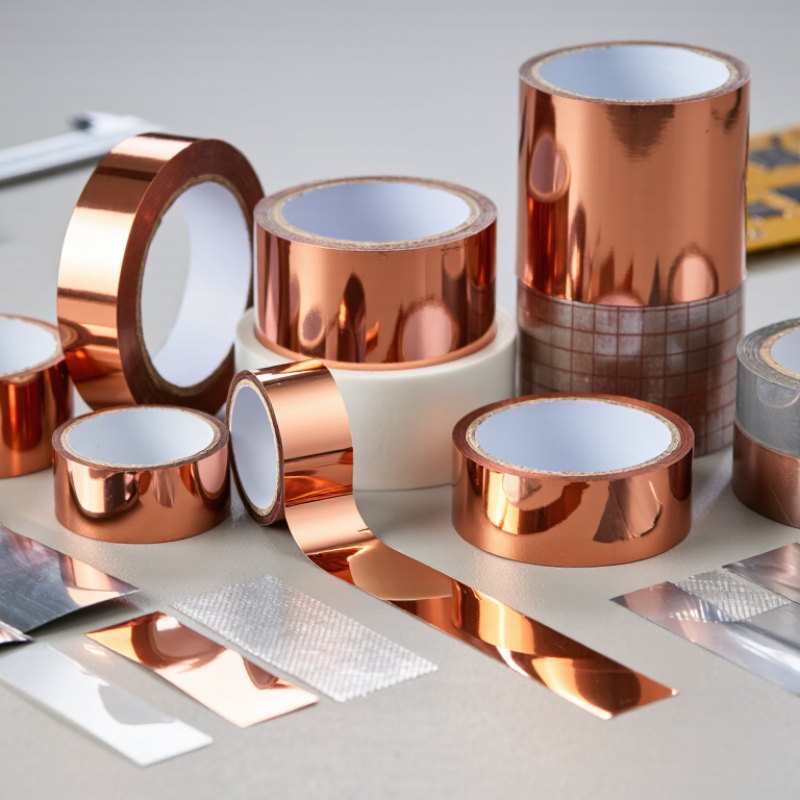
Copper foil tape is a thin copper strip joined to a pressure-sensitive adhesive and usually supplied on a release liner. The copper provides a conductive, formable surface; the adhesive holds it against a panel, enclosure, or cable. Some constructions use electrically conductive adhesive, while others rely on direct contact between overlapping copper surfaces. The difference matters. A tape can look metallic yet fail to conduct reliably across its adhesive layer.
Foil may be rolled and annealed or electrodeposited, giving it different flexibility and surface characteristics. Thickness also affects handling and fit. IPC-4562A classifies copper foil for printed wiring boards by weight; one ounce per square foot is approximately 34.8 micrometres of solid copper. This is a useful comparison, not a universal tape specification. The Copper Development Association’s conductivity data places annealed copper near 100% IACS, or about 58 MS/m at 20°C; actual tape performance also depends on foil temper, adhesive, and contact quality. ASTM B193 describes resistivity testing for conductor materials, but a datasheet figure alone cannot predict performance on a dusty or uneven surface. Test the assembled joint. Small details matter.
2026 Top Copper Foil Tape Types for Global Buyers - What Copper Foil Tape Is and How It Is Constructed
| Tape Type | Typical Construction | Adhesive and Electrical Contact | Common Foil Options | Typical Applications | Key Buying Consideration |
|---|---|---|---|---|---|
| Single-sided copper foil tape with conductive adhesive | Copper foil backing with pressure-sensitive adhesive on one side; supplied with a release liner. | Conductive adhesive is designed to provide electrical contact through the adhesive layer. Contact performance depends on the surface and application conditions. | Rolled-annealed or electrodeposited copper; foil thickness and adhesive system vary by product. | EMI/RFI shielding, grounding, electrical connections and repairs on conductive surfaces. | Check whether the product specifies electrical resistance through the adhesive, and confirm foil thickness, width and temperature limits. |
| Single-sided copper foil tape with nonconductive adhesive | Copper foil backing coated on one side with pressure-sensitive adhesive; typically protected by a release liner. | The copper backing conducts electricity, but the adhesive layer is not intended to provide electrical continuity between the tape and the bonded surface. | Rolled-annealed or electrodeposited foil in a range of thicknesses. | Decorative edging, craft work, surface covering and applications where the copper face is used without a conductive bond through the adhesive. | Do not assume the adhesive creates a grounding path. Where electrical continuity is required, verify the design or choose a conductive-adhesive grade. |
| Double-sided conductive copper foil tape | Copper foil carrier with conductive pressure-sensitive adhesive on both sides, commonly supplied with a liner. | Provides adhesive contact on both faces; electrical performance depends on the adhesive formulation, substrate and bonding conditions. | Usually a thin copper foil carrier selected to suit the required flexibility and bonding task. | Bonding conductive components, grounding interfaces and selected shielding assemblies. | Confirm that both adhesive faces are conductive and that the tape’s thickness and bond strength suit the joint design. |
| Rolled-annealed (RA) copper foil tape | Rolled and annealed copper foil laminated to an adhesive layer; tape construction may be single- or double-sided. | Adhesive may be conductive or nonconductive depending on the product specification. | RA foil is generally valued for flexibility and repeated bending compared with many standard electrodeposited foils. | Flexible circuits, curved surfaces, moving or flexing assemblies and shielding applications requiring conformability. | Review bend requirements, foil temper, adhesive type and any published fatigue or flexibility data. |
| Electrodeposited (ED) copper foil tape | Electroformed copper foil bonded to a pressure-sensitive adhesive; available in different surface treatments and tape constructions. | Adhesive can be conductive or nonconductive; electrical contact should be verified from product specifications. | ED foil is commonly used where a cost-effective copper foil construction is suitable for the application. | General shielding, grounding, electrical repair and industrial or electronic assembly. | Consider foil surface treatment, flexibility, thickness and adhesion to the intended substrate. |
| Tin-plated copper foil tape | Copper foil with a tin surface layer, combined with a pressure-sensitive adhesive and, in many products, a release liner. | Adhesive conductivity varies by grade. The tin-plated face can support soldering where the product is specifically designed for it. | Tin-plated foil; plating coverage and tape construction vary by manufacturer and specification. | Applications requiring a solderable or corrosion-resistant surface, including selected electrical connections and shielding work. | Check solderability, plating details, adhesive compatibility and the required environmental or corrosion performance. |
| Embossed or textured copper foil tape | Textured copper foil backing with pressure-sensitive adhesive; may be supplied with conductive or nonconductive adhesive. | Electrical behavior is determined by the adhesive and contact arrangement, not by texture alone. | Embossed copper foil with patterns and thicknesses that vary by product. | Decorative work, craft projects and applications where a textured copper appearance is desired. | Assess surface profile, conformability, adhesive type and whether the finish must remain visible or be covered. |
Copper foil tape is typically constructed from a copper foil backing, a pressure-sensitive adhesive and a release liner. Foil thickness, adhesive chemistry, electrical resistance, temperature range and performance vary by product; confirm the technical data sheet and test suitability for the intended use.